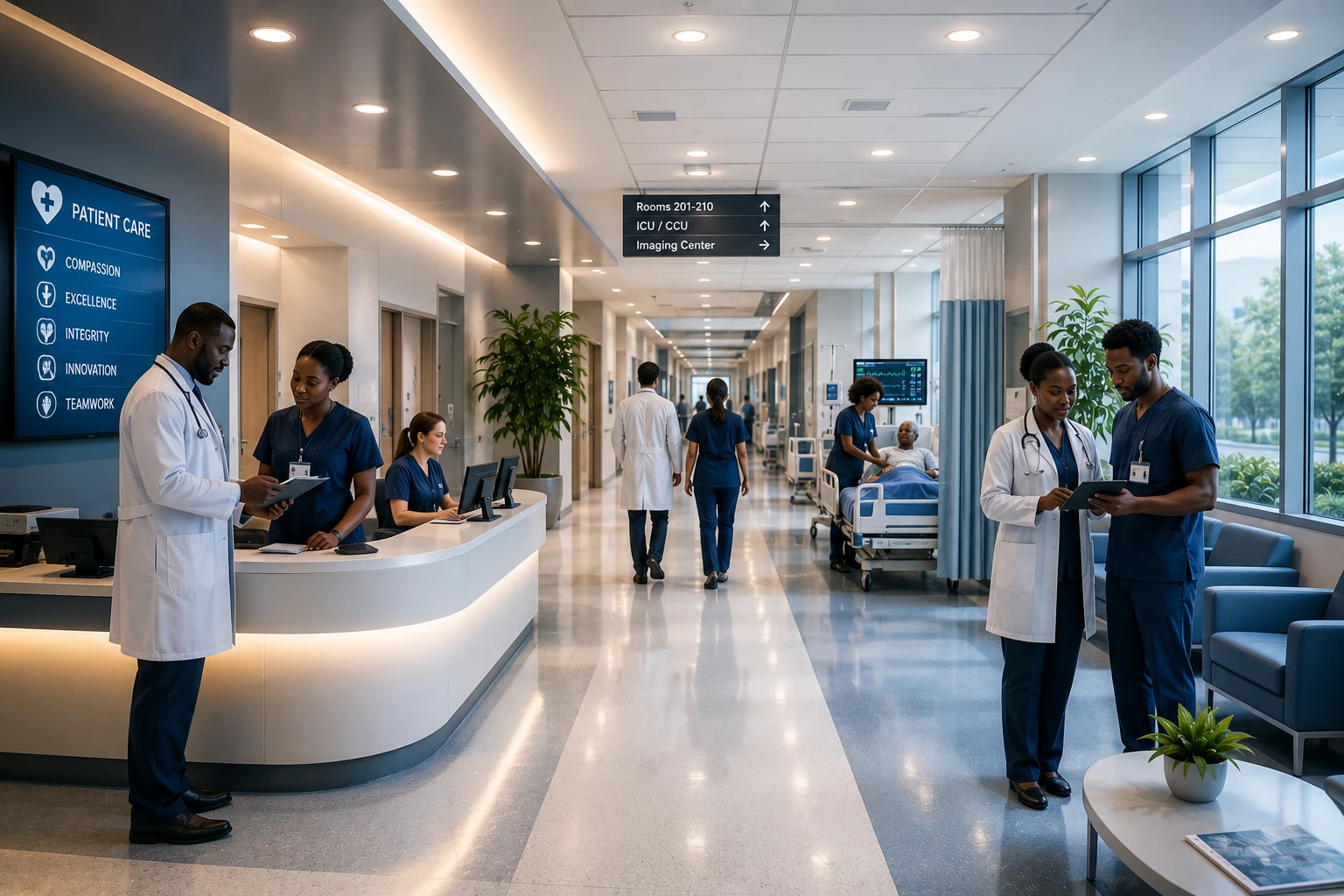
Healthcare
Transforming patient journeys and improving healthcare facility efficiency
DIGITALYS supports hospitals, clinics, health centers, laboratories, pharmacies and care networks in modernizing their operations and patient experience.
Let's discuss your prioritiesKey sector challenges
Long wait times that are difficult to anticipate or manage
Fragmented patient journeys across departments and services
Poor wayfinding and difficulty navigating within facilities
Lack of patient information about delays and next steps
Overloaded reception teams during peak periods
Limited visibility into operational performance data
Unavailability or poor location of medical equipment
Difficulty centralizing and using operational data effectively
A patient journey-centered approach
Each step of the patient journey can be improved with complementary digital solutions, from first contact through to satisfaction collection.
Booking or walk-in
The patient books a time slot from their phone or walks directly into the facility.
Registration
Digital check-in on arrival, reason for visit identified, directed to the right department.
Wayfinding
The patient is guided to the right department via information on their phone or on-screen.
Waiting
The patient tracks their queue position from their phone and receives a wait time estimate.
Consultation
The patient is seen by the practitioner in the order defined by the queue or appointment.
Follow-up tests
If needed, the patient is directed to laboratory, imaging or other specialist services.
Payment, pharmacy or discharge
Settlement, medication pickup or discharge assistance based on individual needs.
Patient satisfaction survey
The patient is invited to rate their experience via QR code, phone or tablet.
Operational data analysis
Indicators collected throughout the journey feed management dashboards.
Our solutions for healthcare
A set of complementary solutions to improve reception, operations and management across your facilities.
Intelligent queue management
Let patients join a queue or track their turn from their phone, without moving to a counter.
Learn moreAppointment & arrival management
Book slots, confirm appointments, send reminders and manage patient arrivals digitally.
Learn morePatient wayfinding
Guide patients at every step of their journey with information sent directly to their phone.
Digital signage
Keep patients informed in waiting areas with centrally managed screens across one or more sites.
Learn morePatient satisfaction surveys
Collect feedback after each visit by QR code, phone or tablet and visualize results in dashboards.
Analytics & operational dashboards
Manage operations with real-time footfall, wait time and satisfaction indicators.
Learn moreCMMS & equipment maintenance
Schedule preventive maintenance, track equipment status and reduce unplanned service interruptions.
Learn moreRFID & asset tracking
Locate equipment, automate inventories and reduce material losses or unavailability.
Learn moreIntelligent queue management
A mobile-first experience centered on the patient's phone, reducing congestion and improving team visibility into patient flow.
From their phone, patients can:
- Book an appointment in a department
- Join a queue remotely
- Select the desired service
- View their position in the queue in real time
- Receive an estimated wait time
- Get notified when their turn is approaching
- Track their wait without staying in the waiting room
- Wait outside when the facility's organization allows it
Service queues covered
The goal is to better distribute patients across time and space, reduce congestion at service points and improve team visibility into real-time patient flow.
Appointment & arrival management
Let patients book a time slot from their phone, confirm their appointment, send reminders and simplify check-in on arrival.
Patient wayfinding and communication
Help patients know where to go, what to do and when to move at each step of their visit.
Patients can find out:
- Where to go within the facility
- Which service or specialist to consult
- Which documents or items to bring
- Which steps remain to be completed
- When to move to the next service
- How long the wait is likely to last
Information delivery channels
Primary channel for notifications, queue tracking and wayfinding.
Tool for patient handling and reception desk communication.
Information visible in waiting areas and corridors.
Operational view for teams managing patient flows.
Digital signage
Centrally managed screens to inform patients, guide visitors and broadcast institutional messages.
Content can be centrally managed for one or multiple facilities from a single interface.
Digital signage complements the mobile experience but does not replace notifications and information accessible on the patient's phone.
Patient satisfaction
Collect ratings after each visit and quickly identify services requiring particular attention.
Ratings can cover:
Collection methods:
- QR code displayed in the facility
- Link sent to the patient's phone
- Tablet made available on-site
- Link sent after the visit
Results are viewable in dashboards and allow quick identification of services or time periods requiring particular attention.
Analytics and operational management
Reliable indicators to manage patient flows, adjust resources and continuously improve reception quality.
Available indicators:
This data enables management to:
- Adapt opening hours and staff schedules
- Better allocate teams based on actual patient flows
- Identify recurring congestion points
- Adjust reception capacity to observed needs
- Compare performance across facilities
- Track the results of improvement actions
CMMS and equipment maintenance
Manage all your medical and technical equipment from a centralized tool to better plan interventions and improve availability.
Better-planned maintenance contributes to reducing service interruptions and improving equipment availability for medical teams.
RFID and asset tracking
Locate equipment, automate inventories and reduce time spent searching for materials.
Examples of trackable assets:
Better visibility into asset location reduces search time, limits losses and contributes to equipment availability when and where it is needed.
Types of facilities covered
DIGITALYS solutions adapt to the specific constraints and patient flows of each type of healthcare facility.
Hospitals
Manage patient flows in high-volume environments with multiple departments and specialties.
Private clinics
Improve patient experience and operational efficiency in a competitive context.
Health centres
Simplify patient reception and consultation management for primary care teams.
Analysis laboratories
Reduce wait times and improve the organisation of patient handling.
Medical imaging centres
Manage appointments, arrivals and patient flow between modalities.
Pharmacies
Streamline counter service and reduce wait times.
Care networks
Manage operations across multiple sites with consolidated indicators.
Health administrations
Improve reception and flows in administratively-oriented structures.
Concrete outcomes for every stakeholder
Tangible, on-the-ground results for each party involved.
For patients
- Less time spent waiting in the waiting room
- Information available on their phone
- Clearer, better-structured journey
- Greater autonomy in managing their visit
- Fewer unnecessary trips between departments
- Option to wait remotely
- Better overall experience
For staff
- Less pressure at reception during peak times
- Reduction of repetitive, low-value tasks
- Better coordination between departments
- Better visibility into priorities and flows
- Faster access to relevant information
- Easier day-to-day flow management
For management
- Reliable indicators to manage operations
- Better human resource planning
- Quick identification of congestion points
- Patient satisfaction tracking over time
- Performance comparison across sites
- Improved equipment availability
- Better visibility across all operations
Our approach with healthcare facilities
A progressive deployment, grounded in your facility's reality, to minimise risk and maximise adoption.
Diagnosis
Analysis of your reception processes, patient flows and operational constraints.
Selection
Identification of solutions suited to your facility type, existing systems and priorities.
Pilot
Deployment on one department or site to validate effectiveness in your real environment.
Measurement
Assessment of results against the indicators defined during diagnosis.
Rollout
Gradual deployment across the full facility or network based on observed results.
Integration with your existing systems
DIGITALYS solutions are designed to connect to your existing ecosystem, without replacing what already works.
Examples of systems where integration is possible:
Integration possibilities are assessed case by case, based on your systems, technical constraints and priorities. DIGITALYS supports you through this analysis.
Data security and confidentiality
Security and compliance topics are addressed from the outset of each project, based on your constraints and requirements.
Data protection
Access rights management and protection of sensitive information.
Access control
Role-based permission assignment and action traceability.
Auditability
Action logging to meet audit and compliance requirements.
Hosting
Hosting choices are discussed with each client based on their constraints.
Backup
Regular backup mechanisms for operational data.
Service continuity
Measures aimed at maintaining the availability of essential services.
Rights management
Permission configuration based on roles and responsibilities.
Regulatory requirements
Applicable regulatory topics are addressed during project scoping.
Let's build a smoother patient journey
Looking to improve reception, reduce wait times, better track your equipment or strengthen operational management?